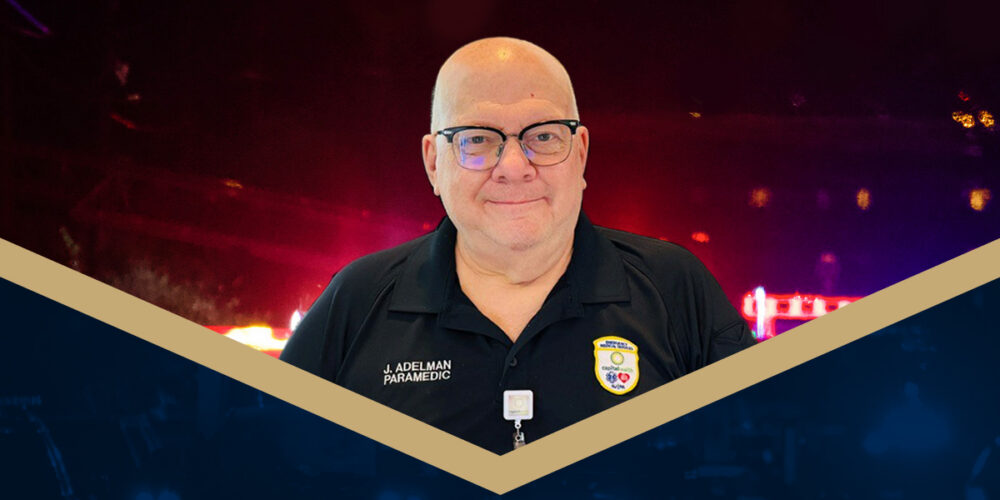
May 17-23, 2026, is National EMS Week, an opportunity to honor paramedics and EMTs for providing life-saving care across our nation’s communities.
Nearly 37 years ago, Joseph Adelman moved his family from Philadelphia to Gloucester County, New Jersey, to seek a better education for his three children.
While driving past a fire station one mile from their home, he said to his wife, “I’m going to join the firehouse.” She looked at him and said, “There’s just no way. That’s not in your persona.”
Fast-forward to today, and Joseph has made an impressive career in emergency medical services (EMS) and continues to dedicate his life to helping others.
From Finance to Founder to First Responder
Joseph worked as a director of finance in the automobile business before becoming a volunteer firefighter with the Washington Township Fire District’s Whitman Square Fire Company.
A few years into his firefighting career, his wife Jill decided to join the Washington Township Ambulance and Rescue Squad. When their children went to school, Jill went from being a stay-at-home mom to volunteer EMT and eventually, a registered nurse.
“My wife is a retired RN who worked at one of the busiest inner-city trauma hospitals in the country,” he said. “Her career set a powerful example of service, resilience and compassion.”
The fire department where Joseph volunteered did not perform medical services. Motivated by a competitive edge after seeing his wife respond to more calls than he did, Joseph became a volunteer EMT, serving both as a firefighter and an EMT for 20 years. In addition, he became chief of the same ambulance squad, working alongside his wife.
With a continual desire to grow, Joseph started his own business in 1997 out of his basement with just two employees.
“I started a business called First Due Emergency Supply, a small mom and pop business where we sold fire, ambulance and police equipment,” he said. “And off we went running, knocking on doors and trying to sell fire equipment and ambulance equipment.”
After taking on a business partner, the company grew with the demand in his area; however, no one expected what came next.
“All of the sudden, we had six employees, and 9/11 came about,” he said. “I was now dealing with homeland security. I was now dealing with the New Jersey Department of EMS. I was now dealing with the Delaware River Port Authority, which takes care of New York and New Jersey. I was now dealing with the city of Philadelphia, and I had some huge contracts. They just needed equipment. Whatever it was, they needed it, and we were there to supply it.”
In addition to being a successful business owner and EMT, Joseph also became a part-time paramedic, working every other weekend at Underwood Hospital, now Inspira Health. After 16 years, he sold his business and became a career paramedic. He currently works as a 911 paramedic for Capital Health, located in the metro area of Trenton, New Jersey.
It’s Never Too Late to Learn and Grow
Having been a business owner and working at a senior management level in the automobile business, Joseph knew he wanted more out of his full-time paramedic career.
“I found myself on the other side, being an employee instead of being in management,” he said. “I know I was as clinically sound as my bosses, but I didn’t understand the operations of a large corporate hospital, and I didn’t understand the operations of a large EMS system.”
In New Jersey, 90% of paramedics must work for a private agency, meaning there is no union. However, Joseph changed that by helping organize one of the first unions in the country for paramedics working for private agencies, a goal he brought to fruition.
“I decided to pursue my degree because I wanted more than experience alone to define my role in EMS—I wanted the academic foundation to match the responsibility of the work and to open doors to leadership, education and long-term impact,” he said. “That was my goal, and I was able to accomplish that through my education at CSU,” he said.
In 2019, Joseph attended an EMS World Expo in New Orleans, where he first learned of CSU. Shortly afterward, he decided to enroll. While returning to college can feel daunting for some adult learners, Joseph remained committed to earning a college education.
“At the start, being a senior learner absolutely mattered,” he said. “At 64, I wasn’t chasing a checkbox or trying to prove I could sit in a classroom. I was pursuing a degree with the intention of keeping my skills current, staying sharp, and remaining competitive and credible in a profession that keeps evolving clinically, operationally and politically.”
“Bottom line: if you feel that pull to do more—teach, lead, improve systems or move into management—a degree is one of the most practical ways to open those doors. And if you’re worried it’s too late or you’ll be the oldest person in the room, I can tell you from experience: learning doesn’t have an age limit, and the return on the effort is real.”
He earned a bachelor’s degree in emergency medical services administration from CSU and is currently pursuing an MBA with a focus on healthcare management.
“My bachelor’s degree in EMS and my current MBA directly support my goals in educational leadership, EMS administration, and hospital-based EMS because they provide a strong clinical foundation and the management tools to lead at the systems level,” he explained. “Together, these degrees are moving me from being an experienced provider and instructor to becoming a leader who can run programs, defend decisions with evidence and metrics, and drive measurable, system-wide improvements in hospital-based EMS.”
A Hidden Talent Emerges
When Joseph started writing papers for his assignments, he never dreamed of what would happen next.
“One thing fellow Knights may find interesting—and definitely relatable—is that I was never much of a writer,” said Joseph. “For a long time, writing felt like a weakness for me, not a strength. But CSU changed that. The writing and research expectations in my courses pushed me to develop skills I didn’t think I had, and over time I started to appreciate my own ability to communicate clearly, support ideas with evidence, and write in a professional voice.”
After reading an article one of his colleagues wrote for the Journal of Emergency Medical Services (JEMS), Joseph called him to inquire about the process.
“I gave him a call and said, ‘How did you do this? This is interesting stuff, what you wrote about.’”
His colleague told him to pick a topic and submit it. After taking that advice to heart, Joseph submitted his first article titled “Balance of Power: How BLS and ALS Partner to Keep You Safe” which explains how the two-tier EMS system divides responsibilities between basic life support crews and advanced life support crews. The article received positive reviews, inspiring Joseph to write more pieces for submission.
“That growth turned into something I never would have predicted: I’m now on staff as a contributor to the Journal of Emergency Medical Services and I’ve been published multiple times,” he said. “What started as ‘I’m just trying to get through this assignment’ became a real professional tool—one that’s helped me share lessons from the field, advocate for evidence-based practice and contribute to the broader EMS community.”
“For me, that’s one of the best parts of this journey: CSU didn’t just give me a degree. It helped me discover skills I didn’t know I had, and it turned a former weak spot into a strength I now use in my career.”
Most of his writings in the journal involve the operational side of being a paramedic, and his many years of experience in the field allows him to contribute in meaningful ways.
“I have an idea of how to make this a better business and how to make this a better business for paramedics and for my industry. That’s my reasoning.”
Joseph’s impressive career includes an instructor with Salem County EMT School, a volunteer retired firefighter of 27 years, staff writer with JEMS, and paramedic. Additionally, he has won numerous awards, including Firefighter of the Year, Most Dedicated Firefighter, and multiple EMS service accolades recognizing ongoing performance, commitment and service. He is also a member of the National Association of Emergency Medical Technicians (NAEMT).
His published articles can be found in the Journal of Emergency Services (JEMS).
Disclaimer: These testimonials may not reflect the experience of all CSU students.
Multiple factors, including prior experience, geography, and degree field, affect career outcomes.
CSU does not guarantee a job, promotion, salary increase, eligibility for a position, or other career growth.